In data and AI, the obvious suspect is almost always the project itself. The pilot stalls, the dashboard disagrees with the one next to it, the forecast gets second-guessed in the very meeting it was meant to settle, and attention turns straight to the model, the vendor or the team that built it. It makes sense, because the project is the part everyone can see.
After years of working with organizations on exactly these situations, we can tell you the visible project is rarely guilty. The cause usually sits further down, where fewer people think to look.
The usual line-up
When something goes wrong, the same names get rounded up first. The AI model is blamed for unreliable answers, although the data it was given may have been incomplete or inconsistent long before the model ever saw it. The dashboard takes the heat for a number nobody trusts, when the real issue is two teams defining the same metric in two different ways. A new platform gets the blame, even though it may have been bought before the foundations were ready to support it, and an ERP program gets the same treatment when it was expected to fix data quality and simply became another silo.
Even the data team and the business users are hauled in for questioning, when ownership was never shared with the business and nobody was given a reason to trust the data in the first place.
All of these suspects have an alibi, and it is usually the same one: the problem was already there before they arrived.
Why AI turns up the spotlight
Trusted data is not a new concern. It has underpinned every wave of technology and business change, and the pursuit of it is as old as the spreadsheet. What AI changes is the speed. A decision once rested on one person reading one report, whereas today the same piece of data can be read by systems at enormous scale, which means that when it is wrong, things go wrong far more quickly.
AI also needs more than access to data. At heart it is making fast, confident predictions from whatever it has been given, and every guess carries a cost, whether that is computational, financial, operational or in governance effort. As agents and automated workflows take over steps a person used to check, a wrong input can be acted on repeatedly and at scale.
Put simply, organizations that invest in AI without matching investment in the data underneath it tend to automate their existing problems, only faster. Gartner points the same way, saying organizations with successful AI initiatives invest up to 4x more in data and analytics foundations. As Russell Pointon, Senior Business Development Manager at Amplifi, puts it after countless conversations with organizations exploring AI: “The idea itself is usually the easy part, the harder part is whether the underlying data is in a state that can support it.”
Following the clues
The good news is that data problems rarely keep quiet. They leave clues, and once you know how to read them, the trail tends to lead somewhere specific:
- AI answers that change depending on who asks or when often point to definitions and context that were never agreed or governed
- Nobody being able to say where a figure came from usually means there is no lineage tracing it back to source
- Reports that were right on Friday and wrong on Monday suggest a quality problem that nothing was watching for
- The same customer appearing three times is the calling card of missing master data
- Nobody knowing who owns a dataset is a governance gap, however good the policy document looks
- Fixes that happen downstream, again and again are a sign that the data was never put right at the source
Look closely and every one of these clues leads to the same place, which is the foundations beneath the visible project.
Fix it at the scene of the crime
This is where we start, and it is why we say we fix data at rest, not in motion. If you correct data every time it is used, you are cleaning up after the same problem forever. If you get it right at the source, with clear ownership, governed definitions, quality controls and the right management in place, it no longer needs fixing every time someone, or something, uses it. That is the difference between a foundation and a workaround. You can read more about how we approach Trusted Data Foundations on our services page.
It does not mean boiling the ocean, either. We diagnose before we prescribe, so every engagement starts by understanding your actual pain points, and we start where you are rather than where we might expect you to be. In practice the most effective foundations are built around one real business problem, with just enough governance, quality and management to make that use case trustworthy, then proven and expanded from there. Governance should make valuable data easier to use safely, not create a maze of approvals.
Amplifi was founded on a simple belief that better data leads to better decisions, and today it leads to better AI. Trusted data, trusted AI and trusted outcomes all follow from the same starting point.
Case closed? Not quite yet
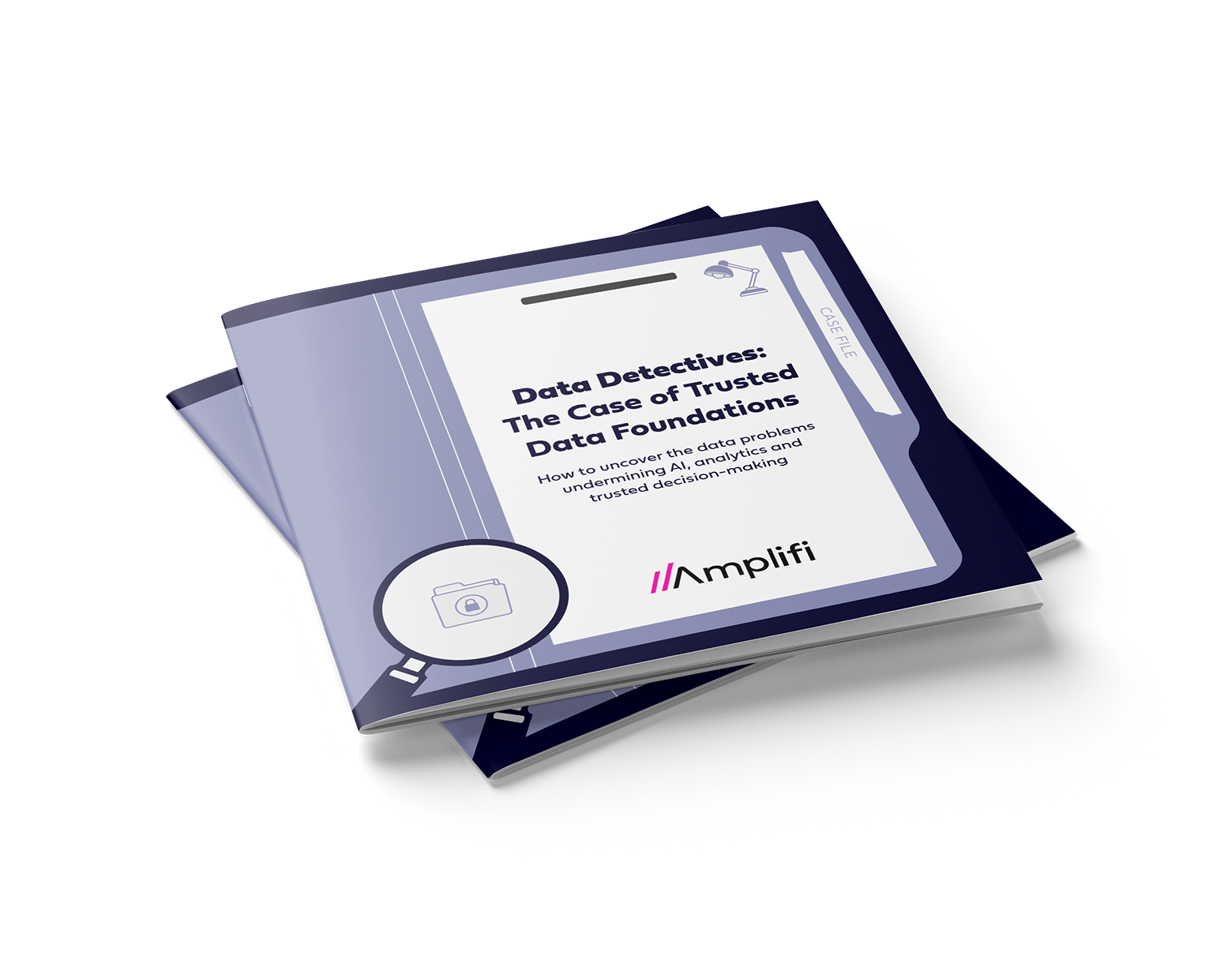
If a project in your organization is under suspicion right now, it is worth looking beyond the obvious suspect. Our new guide, Data Detectives: The Case of Trusted Data Foundations, walks through five common cases, including the missing ROI and the abandoned AI pilot, tracing each from incident to root cause and closing with three practical moves you can try first. It also includes a short self-check to test the strength of your own evidence. You can see the first case unfold in The case of the missing ROI.
And if you would rather have a second pair of eyes on the scene, our Data Capability Assessment measures your data capabilities across six core areas and shows how ready your organization is to deliver on its data and AI ambitions. You get an evidence-based baseline, clear recommendations and a prioritized action plan, not a slide deck.
Learn more about the Data Capability Assessment
Or if you’d simply like to talk it through, talk to a data expert.