One of the highest-value use cases stemming from a Master Data Management (MDM) platform is powering AI and analytics. However, realizing that value depends on how mastered data flows through your data architecture. Integrating MDM into the Medallion Architecture is critically important, yet it remains one of the least defined parts of building a modern data platform. Luckily, Amplifi is here to help, with years of experience in building MDM programs and driving high-value analytics.
Medallion Architecture needs trust
The Medallion Architecture is a common framework that organizes analytics data into progressively refined layers, commonly referred to as Bronze, Silver, and Gold, to improve reliability, traceability, and analytical readiness. Data is ingested in its raw format into the Bronze layer, cleaned and standardized in the Silver layer, then curated into business-ready datasets in the Gold layer. This layered structure helps organizations scale analytics consistently while clearly communicating how data evolves from source systems to trusted insights.
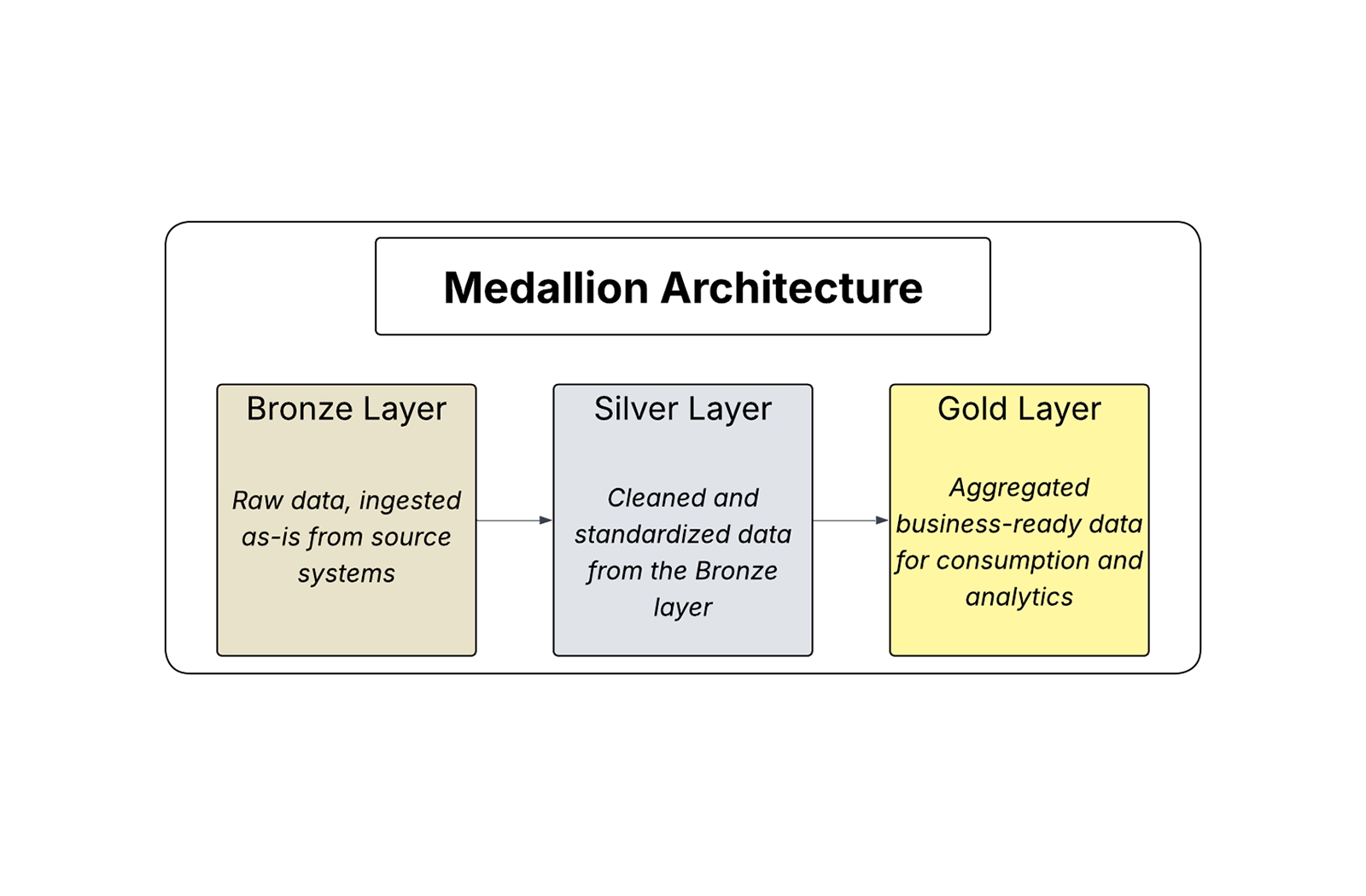
Figure: The Bronze, Silver, and Gold layers of the Medallion Architecture.
Within the broader enterprise data landscape, the Medallion Architecture serves as a disciplined framework for transforming disparate system data into a unified, analytics-ready foundation that enables reliable insights, advanced visualization, and scalable AI capabilities.
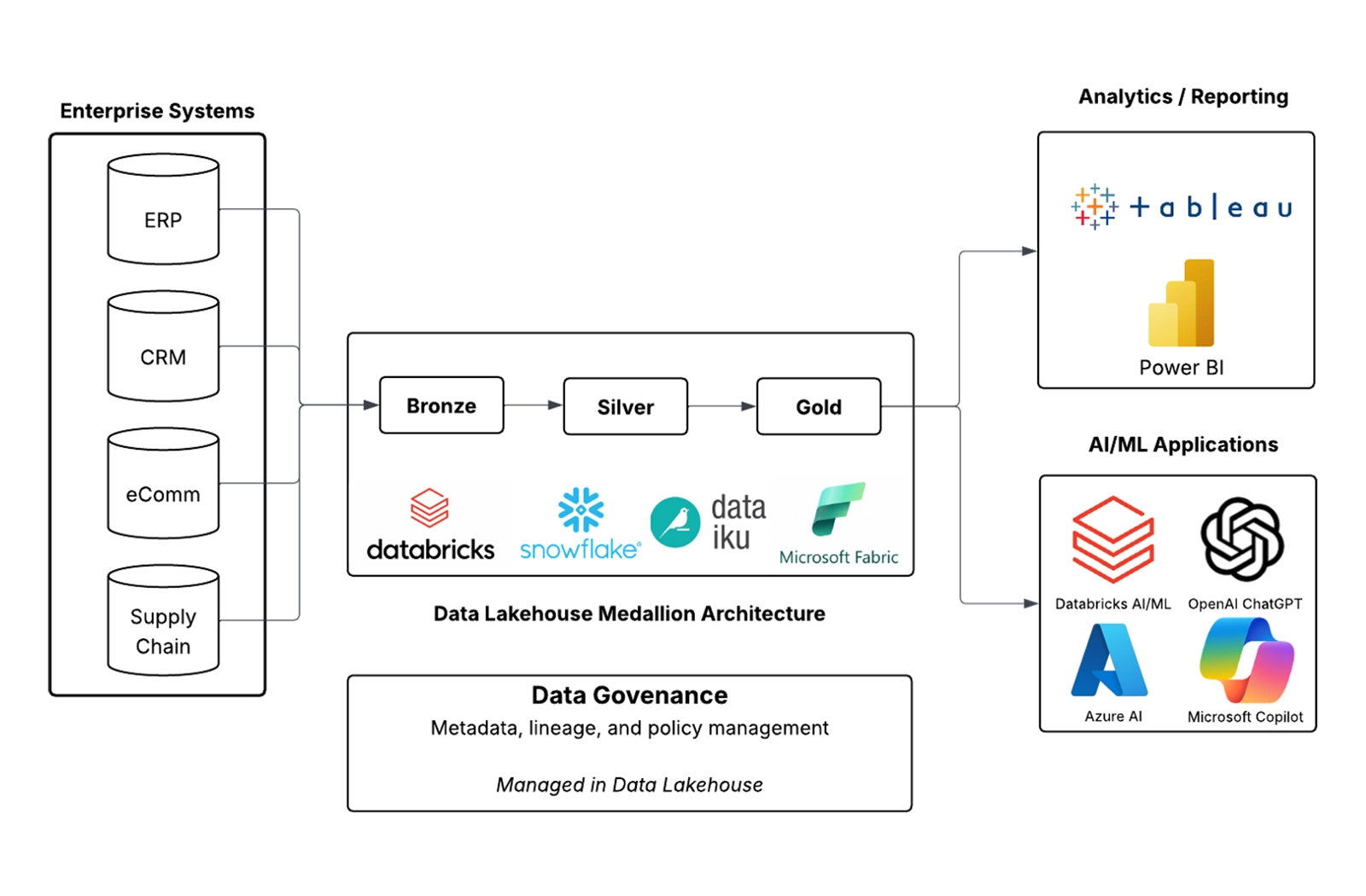
Figure: The Medallion Architecture integrated into the broader enterprise data landscape.
All great analytics initiatives, from reliable reporting to interactive dashboards to AI chat bots, rely on high-quality data. For many data teams, ingesting and cleaning data is the most time-consuming part of a project. Ensuring that data quality is pristine (no missing or duplicate values, consistent naming conventions, and understanding all data sources) is paramount to success.
Data engineers are regularly blocked by data quality issues. When you have the same customer listed as “Adam Smith” and “Smith, A” in the same database, progress stops. If you have the same product ID but two different descriptions, progress stops. Even getting a business decision on which field should come from which system can take months of meetings and emails.
If these quality issues make it to your end user, you lose the most valuable part of any analytics product: trust.
The Medallion Architecture provides a framework on how to move from raw source data to consumer-ready data, but inherently does not define the processes and decision-making needed to build trust in your Gold analytics data. That’s where MDM comes into play.
MDM’s role in reliable, governed data
Master Data Management as a practice defines all the hard-to-answer questions that plague data architecture development. Through a comprehensive implementation of an MDM platform, the business will align on the following questions:
- What are the critical data elements for each business domain, and how are they defined?
- Who owns and governs these data elements from a business accountability perspective?
- What is the authoritative source (system of record) for each data element?
- How is data quality measured, and what standards must the data meet?
- When data is incorrect or misaligned, who is responsible for remediation and how is it resolved?
In practice, an operational MDM platform turns these definitions and governance decisions into action by increasing the speed and scale at which people work with data. When embedded into day-to-day business processes, MDM enables teams to efficiently use, enrich, and correct trusted data closer to the point of use. This reduces latency and rework while improving data completeness and quality, fundamentally changing how people engage with data. This increases the volume, timeliness, and reliability of data available for analytics and AI driven use cases.
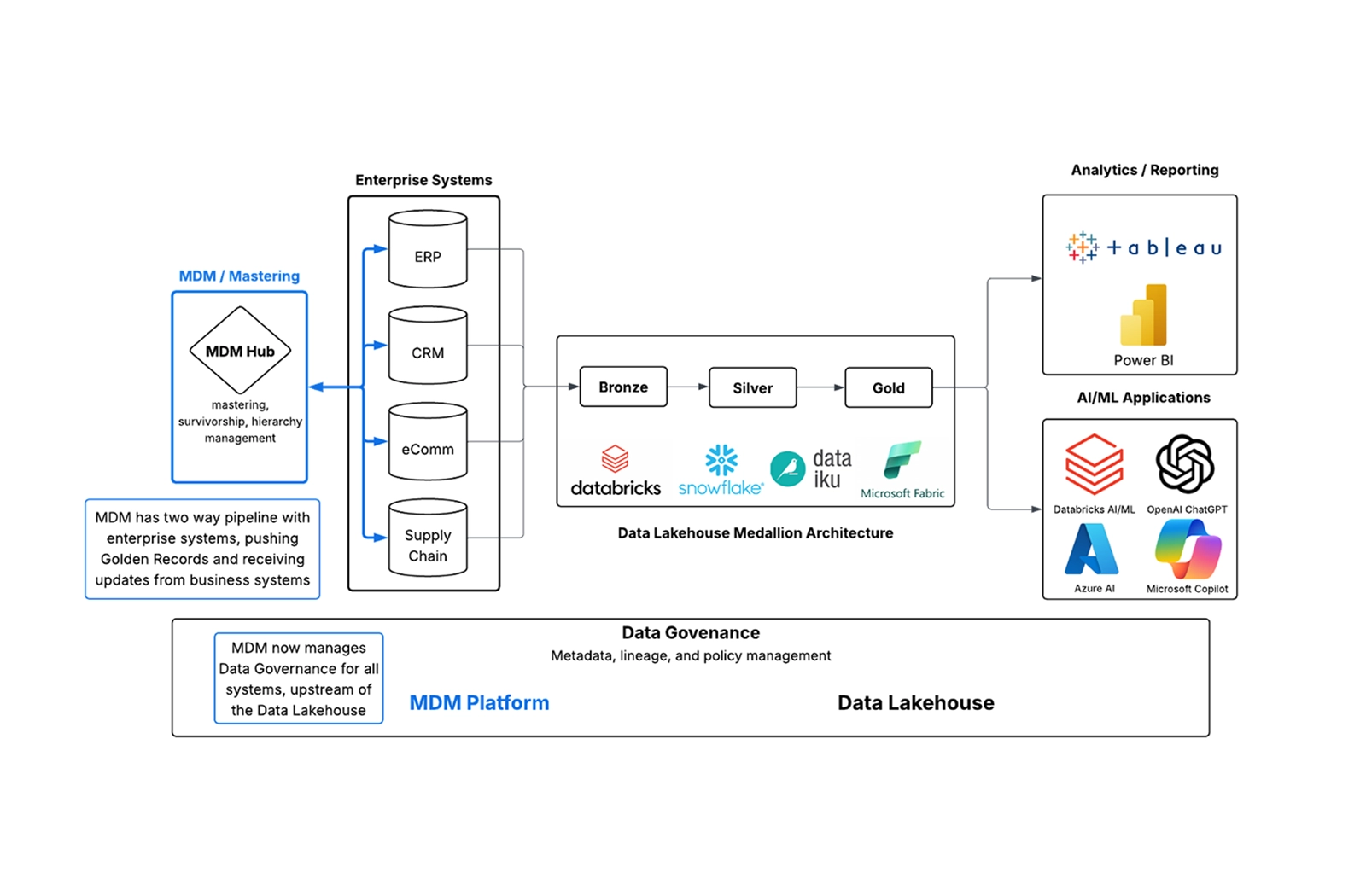
Figure: MDM integrated upstream of enterprise systems, expanding data governance.
Having the right systems and people in place to govern data enables one of the most important outputs of an MDM platform: the golden record. Golden records are a single, trusted, analytics-ready representation of a master data entity, created by resolving duplicates and inconsistencies across multiple source systems.
This trusted foundation allows organizations to confidently drive value from their data, increasing revenue, minimizing risk, or reducing operating costs. Often MDM implementations support core initiatives such as eCommerce, PXM, ERP implementations, and broader digital transformation efforts. It is also especially important to your data architecture, where consistent and reliable master data underpins the ability to realize meaningful outcomes from analytics initiatives.
Turning Gold into Silver
In a traditional Medallion Architecture, the Silver layer represents standardized, trusted, and conformed data, while the Gold layer is shaped for specific analytical use cases. When viewed through this lens, MDM golden records align much more closely with the purpose of Silver data than Gold.
Silver layer tables, like golden records, are:
Standardized and conformed: Silver layer tables are standardized and conformed to enterprise data models, reference data, and consistent business semantics to ensure alignment across the organization.
Trusted and high-quality: Silver layer tables contain trusted, high-quality data that has been cleansed, validated, and measured against clearly defined business rules.
Resolved and authoritative: Silver layer tables resolve duplicates and consolidate data from multiple systems into a single, trusted version of each entity.
Governed and traceable: Silver layer tables are governed and fully traceable, with end-to-end lineage back to source systems, auditability, and historical change tracking.
Analytics-ready but not analytics-shaped: Silver layer tables are analytics-ready and reusable across different analytics use cases but need to be supplemented and reshaped in order to service those analytics use cases.
That’s why in your data architecture you “turn” your golden records into Silver data to build upon.
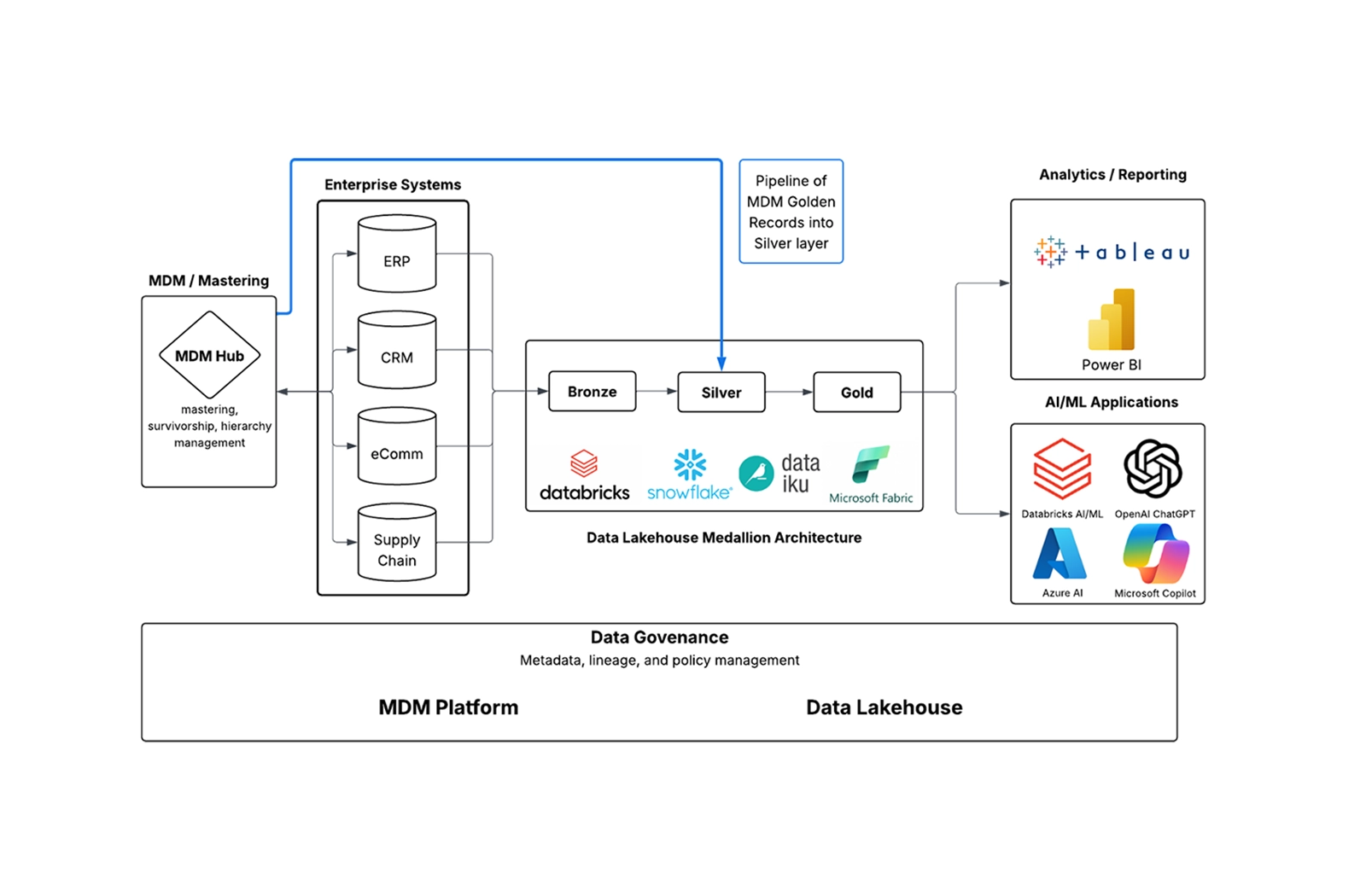
Figure: Pipeline of MDM golden records into the Silver layer of the Medallion Architecture for trusted data flow.
Let’s consider how these concepts apply to customer data. Customer records can exist in many different systems that often have conflicting data (email, address, etc.). When designing dashboards that work across systems or domains, it’s up to data engineers to determine which customer records or counts of customer records are correct. Without proper business alignment, there will always be a discrepancy from what different business users view as the source of customer data.
With a Customer MDM solution, all your consolidated customer records are sitting right in your Silver layer. You can link those mastered customer records to POS transactions, eCommerce activity, marketing preferences, order history, etc. to create Gold layer views for analysis, reporting, and/or visualization.
Building a foundation of governed data that AI can trust
Having trust in your data becomes even more important in the world of AI. As humans are removed from the loop in AI applications, organizations lose the built-in expertise of people who understand the nuances of how customer and product data is collected, enriched, and used. That accountability is a primary cost for the incredible abilities and efficiencies that AI can drive with your data.
The only way to trust AI is to wholly trust the inputs, which makes MDM and data governance more important now than ever before. Once those are in place, it’s then critical to make that data available and usable for your AI initiatives. The pipeline from MDM golden records to well-defined Silver tables is crucial to the success of your AI initiatives. It truly is the backbone of what makes a trustworthy AI product.
Consider the application of AI Agents across your enterprise. Marketing, customer service, sales, and other teams will all depend on these Agents to access and act on customer data. With a strong MDM-to-Medallion pipeline, every Agent draws from the same trusted source, eliminating silos and ensuring consistency. This isn’t just about reducing errors; it’s about enabling scale and speed. When AI is powered by clean, governed master data, organizations can automate decisions confidently, deliver personalized experiences, and unlock new opportunities. Trusted data is the foundation that turns AI from a tactical tool into a strategic driver of growth.
Trusted data is your most valuable asset
Turning golden records into Silver data will deliver the most valuable asset to your analytics and AI projects: trust. Building a comprehensive MDM solution, a sound Medallion Architecture, or planning your next big AI initiative is anything but simple. Luckily, Amplifi is here to help.
We have years of experience in helping our customers bring their data projects to life, starting from messy, ungoverned data to achieving unrealized MDM potential. Read our top tips for getting started with Microsoft Fabric below, where to begin with understanding the building blocks of MDM, or get in touch to speak to one of our experts about your unique needs.
About the Author
Mike Hennelly is a Data Consultant at Amplifi with 5 years of experience helping customers successfully process and analyze data. A certified Databricks Data Engineer and Databricks Data Analyst, Mike has experience successfully developing pipelines, dashboards, and analytics solutions in the advertising and logistics verticals. Recently, Mike has worked to bridge the gap between MDM implementations and analytics projects to help organizations get the most out of their master data.
If you would like to speak with Mike about Databricks or driving analytics success from your MDM program, please fill out our contact form.