Today, organizations invest heavily in sophisticated data governance tools — data dictionaries, catalogs, and AI-powered solutions. Yet many of these initiatives fail to deliver their promised value. Why? Because they overlook a fundamental challenge: the communication gap between technical teams and business users.
While data specialists may navigate complex data structures with ease, they need a robust business glossary to transform raw information into meaningful insights for the business. Without it, your business users may not fully understand the depth of the important insights being shared with them and how they impact the organization.
Without this critical translation tool, your data governance program runs the risk of becoming an exclusive “playground” for technical specialists while everyone else retreats to familiar departmental silos.
The business glossary: the key to accessibility
The solution to bridging this gap is simpler than you might think: a business glossary. Think of a business glossary as your organization’s internal Wikipedia. It’s a collaborative and searchable environment that explains business concepts and links terms together to describe the inner workings of your organization in plain language. Definitions and new terms can be added and enhanced in a controlled manner with checks and balances.
According to the Government Digital Architecture Community, a well-structured business glossary serves as the foundation for clear organizational communication and data understanding. Unlike technical documentation, it focuses on meaning rather than structure, explaining what data exists, why it matters, and how it should be used.
Business glossaries can exist without being a formal tool. Often in large organizations, individual departments may have a glossary of terms or three-letter acronyms (TLAs) as a reference document or onboarding material. Even informal documentation like this can be a solid foundation for building the success of large-scale governance and analytics programs.
To understand the value of a business glossary, it helps to distinguish it from similar tools:
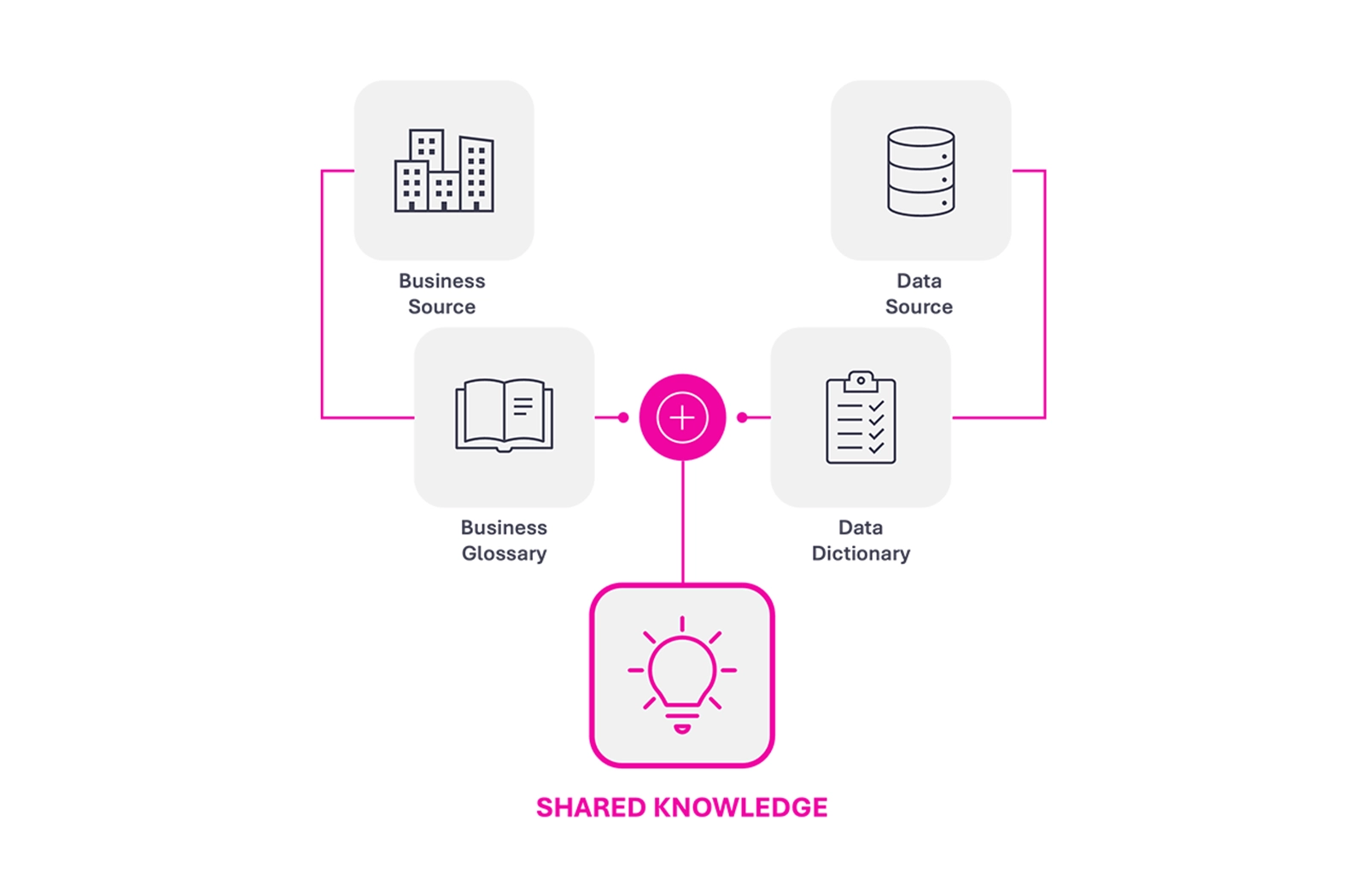
- Data Dictionary: A collection of metadata that describes your data’s technical aspects—field names, data types, and allowable values. It answers “what” and “where” questions about your data.
- Data Catalog: A comprehensive inventory of data assets, including reports, dashboards, and source systems. It helps technical users navigate your data ecosystem.
- Business Glossary: The critical bridge that translates technical information into business concepts. It answers the “why” and “how” questions that make data meaningful for decision-making.
Breaking down silos and managing business complexity
One of the most significant challenges in modern organizations is the proliferation of knowledge and process silos. Each team develops its own vocabulary, processes, and ways of managing data. A business glossary centralizes scattered department glossaries, acronym lists, and previously undocumented knowledge in one accessible location. This creates a single source of truth for your organization’s terminology, concepts, and processes that can be flexible enough to handle context-specific definitions.
Context matters, and we can’t pretend that conflicting definitions don’t exist. A business glossary is the key to handling these conflicts. For instance, your marketing department may refer to “Sales Qualified Lead” as SQL, but your analytics team knows it as “Structured Query Language”. Both definitions can (and should) coexist peacefully in a business glossary. When integrated with your data dictionary or catalog, these definitions can link directly to relevant fields, tables, reports, and other data assets.
Keys to business glossary success
Through our experience working with a variety of organizations, we’ve identified three crucial factors for maximizing the ROI of a business glossary:
- Universal access is non-negotiable.
Make sure everyone in your organization can access the business glossary. If your software vendor charges extra for business glossary licenses, consider the true cost of limited access—disconnected definitions, misinterpreted data, and ultimately, poor decision-making. The cost of restricted access far outweighs any initial savings on licensing fees. - Embrace user feedback.
Choose a platform with a robust workflow for definition changes and additions. When employees can suggest updates and see their knowledge integrated into the system, it builds trust and encourages platform adoption. Without this feedback mechanism, users become frustrated and may revert to maintaining their own separate documentation, circumventing the entire data governance process. - Regular maintenance is key.
Like any valuable resource, a business glossary requires ongoing attention. Establish a regular review cycle to ensure definitions remain current and relevant. Assign clear ownership for different sections of the glossary to a data owner and their data stewards and create processes for retiring obsolete terms.
Building a culture of data literacy
When implemented correctly, a business glossary becomes more than just another tool — it becomes an integral part of your organization’s daily operations. It fosters clear communication, promotes shared understanding across departments, and helps build a culture of data literacy from the ground up.
The key to success lies in making the business glossary an essential part of your employees’ daily workflow.
- Encourage its use in meetings and company communications.
- Include it in onboarding materials for new hires.
- Link to relevant glossary terms in reports and dashboards.
- Recognize and reward contributors who improve the glossary.
The groundwork for advanced analytics
A solid data governance program built on the foundation of a comprehensive business glossary paves the way for more confident data-driven decisions and enables more advanced applications like AI and machine learning.
Remember, successful data governance isn’t just about having the most sophisticated tools — it’s about making data knowledge accessible to everyone in your organization. By investing in a comprehensive business glossary and maintaining it properly, you’re not just creating a reference tool, you’re building a foundation for better communication, more efficient operations, and more informed decision-making across your entire organization.